For decades, the construction industry has grown accustomed to thinking in phases: first planning, then bidding, then construction, then handover, then operation. Each phase has its own documents, responsible parties, conflicts, and justifications.
This way of thinking is becoming increasingly ill-suited to a world where buildings are expected to be more energy-efficient, available faster, digitally documented, more climate-friendly, and economically robust.
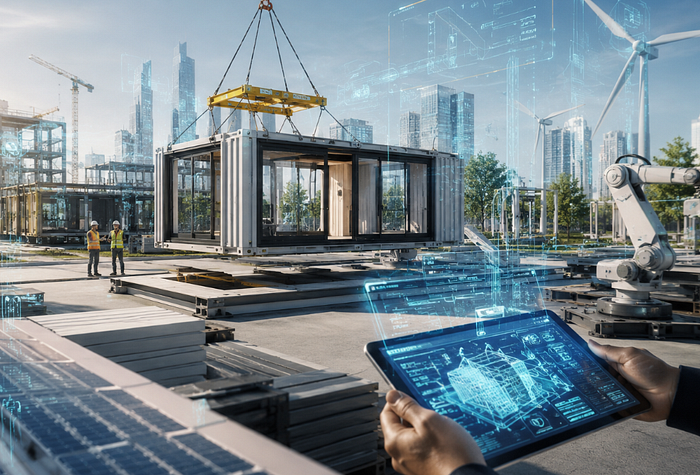
The new development does not lie in a single trend. It lies in the combination of several trends: modular manufacturing, AI-supported energy management, and digital production systems.
Modular manufacturing shifts value creation to controlled environments. Digital production systems make planning, material flow, quality, and assembly more controllable. AI-supported energy management connects buildings, user behavior, storage, generation, and grid signals. Together, a new picture emerges: the building is no longer understood merely as a project, but as a learning system.
Research already indicates that digital technologies such as BIM, IoT, and energy modeling are playing a growing role in modular construction. At the same time, the widespread application of fully automated digital twins and AI in sustainable modular construction remains a task for future development.
This is important. Because it guards against hype.
In practice, people often jump too quickly from technology to impact. A digital model does not automatically mean better coordination. Modular construction does not automatically mean better quality. An AI system does not automatically mean lower energy costs. Impact only arises when the organization behind it is stable enough to use these tools.
This is where Lean Construction comes into play.
Lean Construction is not just a collection of methods. It is an attitude toward work. Work should be able to flow. Obstacles should become visible early on. Commitments should be reliable. Deviations should not be covered up, but learned from. That sounds simple, but it is challenging in complex construction programs.
When modular manufacturing is used, a clear product and platform logic is required. Which modules are standard? Which variants are allowed? Which connections are critical? Which tests are performed in the factory, and which on-site? Without these answers, no industrial advantage is created, only a new form of project uncertainty.
When digital production systems are introduced, information discipline is required. ISO 19650 can serve as a framework for BIM-based information management here. IFC according to ISO 16739–1:2024 supports open data exchange. ISO 50001 provides guidance for systematic energy management.
When planning AI-based energy management, clear operational goals are needed. Should self-consumption be increased? Should peak loads be reduced? Should comfort levels remain stable? What data may be processed? Who bears responsibility if automation makes the wrong decisions?
These are not IT questions. They are leadership questions.
From Hellmuth-Sander-Consulting’s perspective, that is precisely where the leverage lies. HSC is not a run-of-the-mill consultancy for abstract transformation programs. We work where projects require stability, clear governance, robust implementation, and strong leadership intervention. For critical infrastructure, supply chain, and transformation programs, the rule is: First, the system must become operational. Only then can it improve.
The coming years will show which organizations take smart infrastructure seriously. Not by the presentations. Not by the pilot labels. But by the metrics.
Will weekly commitments become more reliable? Will rework decrease? Will actual energy performance improve? Will peak loads become more controllable? Will data remain accessible? Will operators be involved earlier?
These are the litmus tests.
The end of the siloed construction site does not mean that everything is automatically integrated. It means that integration must be managed. That is precisely where it will be decided whether modular manufacturing, AI, and digital systems contribute to true sustainability — or merely to new complexity.